 |
| Photo by craig1black |
We can save ourselves a lot of extra effort and capital if we are honest with ourselves and aware of the impact of our choices, and what they really mean.
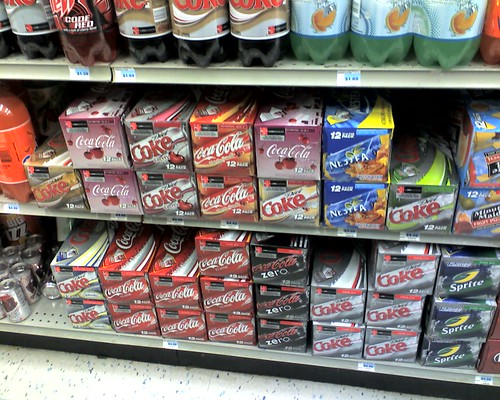
Say you are at home one day and an old friend calls you up to see if you would like to catch up. You go over there and she offers you a drink. "Can I get you something to drink" she asks. "Sure, what do you have" you respond. "Coke, Diet Coke, Coke Zero, Diet Lime Coke, Lime Coke, Diet Cherry Coke, Cherry Coke" at which point you interrupt her and say "Cheryl, that's all just coke". Or maybe you are a little more discerning and you say "that's all just soda".
Are these all valid choices? Sure. But keep in mind during this story your choices were more limited than you would have been comfortable believing. We often take what is presented to us at face value, but wouldn't it be more appropriate to consider good choices in drink options a choice between water, apple cider, soda, tomato juice, or a mixed beverage? Often our optimal choice might not even exist, but that's neither good nor bad, just something to remember when we get worked up about trying to decide between colors of soda when there is something more deserving of our time.
Secondly, choice can be used against us, especially when we don't know the worth (to ourselves) of the item we want to purchase. We will often look to other signals we should be more cautious about to inform us of what our correct choice should be. Because make no doubt about it, as western people we have been taught that there is a right and a wrong choice for just about everything.
A professor recently gave us an interesting article in which they related how a prominent journal had advertised three service plans in which to receive the journal.
- Online version only for $59.99
- Traditional journal (mailed to your destination) for $109.99
- Traditional journal plus online version for $119.99
Overwhelmingly (about 80%) of people chose option 3, since they got the most value for their money.
Keep in mind, the company set these prices. Who is to say you are really getting the best deal? We crunch the numbers in our head while thinking "if I get both options I'm saving $50.00", when instead we may be spending $10 more for a service we won't use, or $60 more for a service we won't use.
Interestingly enough, the professor tested a different group of people on the same product, minus choice 3.
- Online version only for $59.99
- Traditional journal (mailed to your destination) for $109.99
This time about 80% of respondents chose option 1. The price told them that the traditional journal was not worth almost double the fee for an online version.
Both times the respondents walked away feeling they had made the best choice, but how can that be given the same set of options 1 or 2? We are often not aware of how much we are manipulated by indicators that tell us what to choose, especially in believing that price equals quality.
Next time you find yourself making a purchasing decision, pause and think "how am I being manipulated" and "what do I really want". Your answer might surprise you.

No comments:
Post a Comment